

When I compare an MVR falling-film evaporator with a multi-effect evaporator, I first look beyond the equipment label. Buyers can face high energy costs, fouling, unstable operation, or an unsuitable downstream process if they choose only by quoted steam consumption. I use material data, operating conditions, and whole-life economics to identify the safer route.
An MVR falling-film evaporator is not universally better than a multi-effect evaporator. MVR can be attractive when electricity is reasonably priced, operating hours are high, and reducing fresh steam consumption has strong economic value. Multi-effect evaporation can be preferable where steam is inexpensive, electricity is costly, or the process requires a simpler and more familiar heat-integration arrangement. Material viscosity, scaling, solids, corrosion, heat sensitivity, cleaning requirements, and downstream crystallization must also be evaluated before a final selection.
I have participated in process proposals and technical evaluations for chemical and high-salt wastewater projects. In those evaluations, the most useful question was rarely “Which evaporator has the lowest steam consumption?” The better question was, “Which complete process can achieve the required result with acceptable energy, uptime, maintenance, and lifecycle cost?”
What Is the Difference Between an MVR Falling-Film Evaporator and a Multi-Effect Evaporator?
Many buyers compare these systems as if they were completely different equipment categories. That approach can create confusion because falling-film evaporation describes liquid distribution and heat-transfer configuration, while MVR and multi-effect evaporation primarily describe how thermal energy is supplied and reused. I separate these concepts before comparing suppliers.
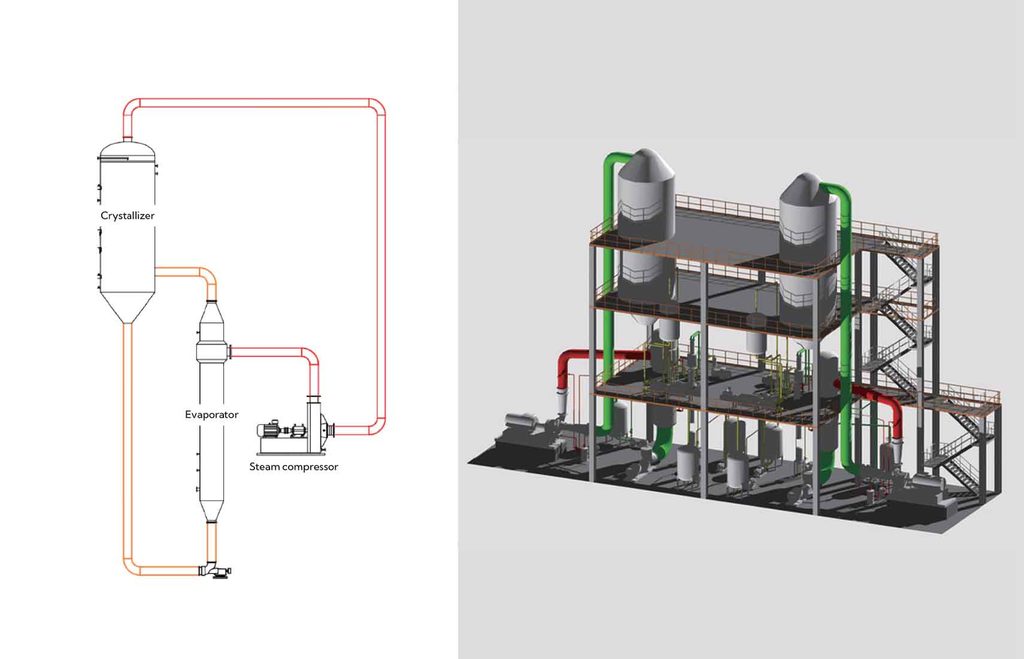
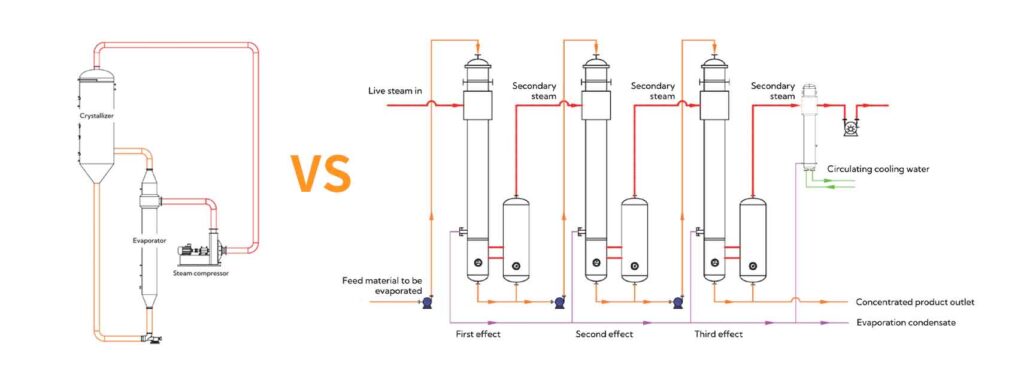
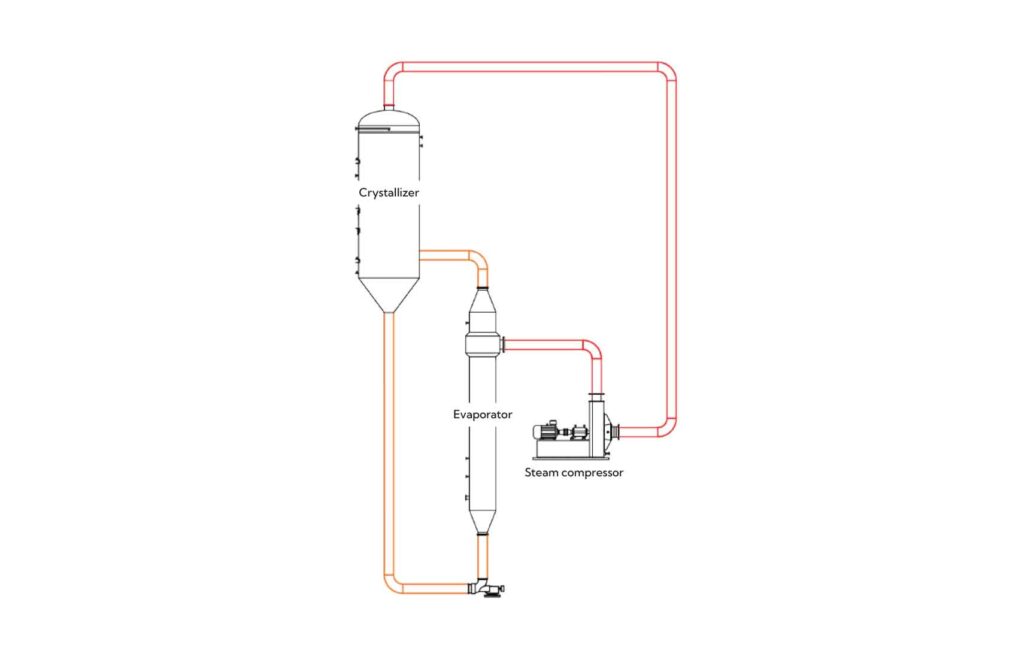
An MVR falling-film evaporator uses a mechanical vapor compressor to recompress secondary vapor and reuse it as a heating source. A multi-effect evaporator uses several effects at progressively lower pressures and temperatures, allowing vapor from one effect to heat the next. A falling-film evaporator can be used within different thermal arrangements, so the terms are not always mutually exclusive.
Falling-Film Evaporation Describes the Equipment Structure
In a falling-film unit, liquid enters the upper section of heat-transfer tubes and flows downward as a thin film. The thin film can provide efficient heat transfer and relatively short residence time. These characteristics may benefit heat-sensitive products and liquids that can be distributed evenly.
However, the configuration also depends on reliable wetting. I would ask a supplier to explain how the system handles:
– Changes in feed flow rate
– Uneven liquid distribution
– Increasing viscosity during concentration
– Suspended solids or crystals
– Foaming and entrainment
– Tube blockage and cleaning access
A falling-film design may become difficult to operate when the material becomes highly viscous, crystallizes inside tubes, or contains solids that disturb film distribution. The actual answer depends on the material and the selected concentration range.
MVR and Multi-Effect Describe Thermal Strategy
MVR uses electricity to drive a compressor. The compressor raises the pressure and temperature of secondary vapor so that the vapor can serve again as heating steam. The system can therefore reduce dependence on fresh steam, but it introduces electrical consumption, compressor investment, controls, and maintenance requirements.
Multi-effect evaporation uses the temperature difference between effects. Fresh steam heats the first effect, and vapor generated in that effect heats the second effect. Additional effects can reduce steam consumption, but the equipment may require more heat-transfer area, a suitable steam supply, and careful pressure balancing.
| Evaluation point | MVR falling-film route | Multi-effect route |
| Main energy input | Electricity, with limited startup steam in many designs | Fresh steam |
| Major energy advantage | Lower fresh-steam demand | Uses available steam efficiently |
| Main additional equipment | Vapor compressor and electrical system | Multiple effects and steam-condensing arrangement |
| Typical economic driver | High operating hours and favorable electricity price | Low-cost or available steam |
| Key technical risk | Compressor operation, fouling, and material suitability | Steam cost, temperature profile, and heat-transfer area |
| Best selection method | Project-specific energy and lifecycle model | Project-specific energy and lifecycle model |
I also remind project teams that MVR is not automatically a complete solution for crystallization. If the process must produce crystals, separate salts, or reach zero liquid discharge, the evaporator may need to work with a forced-circulation evaporator, OSLO crystallizer, DTB crystallizer, cooling crystallizer, or another separation step.
When Is an MVR Falling-Film Evaporator the Better Choice?
An MVR falling-film evaporator may be a strong candidate when I see long annual operating hours, high fresh-steam costs, suitable electricity pricing, and a feed that can be concentrated without severe fouling or viscosity problems. The decision becomes stronger when the evaporator forms part of a larger recovery or ZLD system.
MVR is often worth evaluating when a project values reduced steam demand, heat recovery, compact thermal integration, and continuous operation. It is not automatically the best choice when the material is difficult or when electricity and compressor maintenance dominate the cost model.
Energy Economics Matter More Than a Single Steam Figure
I never evaluate MVR using steam consumption alone. I request an operating-cost comparison that includes at least:
1. Electricity price and expected price changes
2. Steam price, pressure, and availability
3. Annual operating hours
4. Feed capacity and evaporation duty
5. Compressor power and efficiency assumptions
6. Startup and standby requirements
7. Cleaning frequency and downtime
8. Maintenance costs and spare parts
9. Cooling-water and condensate conditions
10. Required downstream crystallization or drying
For example, a site may have inexpensive waste steam available from another process. In that case, a multi-effect evaporator could be more commercially attractive even if its fresh-steam consumption is higher than an MVR design. Another site may operate continuously and face expensive boiler steam. In that situation, MVR may deserve closer evaluation because electricity can replace a substantial part of the fresh-steam demand.
I also examine the annual utilization rate. A compressor and related electrical infrastructure represent capital expenditure. If the system operates only intermittently, the financial return may be weaker than expected. If the plant operates continuously for most of the year, the same investment may be easier to justify.
When Material Characteristics Support Falling-Film Operation
Falling-film evaporation can be useful when the liquid has good flowability, manageable viscosity, limited solids, and acceptable scaling behavior. Low residence time can also support products that are sensitive to prolonged heating.
In a chemical or wastewater project, I would request laboratory or pilot information about:
– Density and viscosity at feed and outlet conditions
– Solubility and crystallization behavior
– Total dissolved solids
– Suspended solids and particle size
– pH and corrosive components
– Organic content and foaming tendency
– Scaling rate on representative heat-transfer surfaces
– Product sensitivity to temperature and residence time
A supplier should not make a final recommendation from only the feed concentration and flow rate. Two streams with the same salt concentration can behave very differently because of organic impurities, calcium, silica, sulfate, chloride, or other components.
MVR Still Requires a Reliable Process Design
An MVR system includes more than an evaporator body and compressor. I evaluate vapor separation, demisting, condensate quality, control logic, compressor protection, cleaning arrangements, and integration with the rest of the plant.
For ZLD projects, I also ask how the concentrated brine will move into crystallization. A system that performs well during the early concentration stage may become unstable near the solubility limit. The process designer may need to change from falling-film evaporation to forced circulation or another configuration before crystal formation becomes excessive.
When Is a Multi-Effect Evaporator the Better Choice?
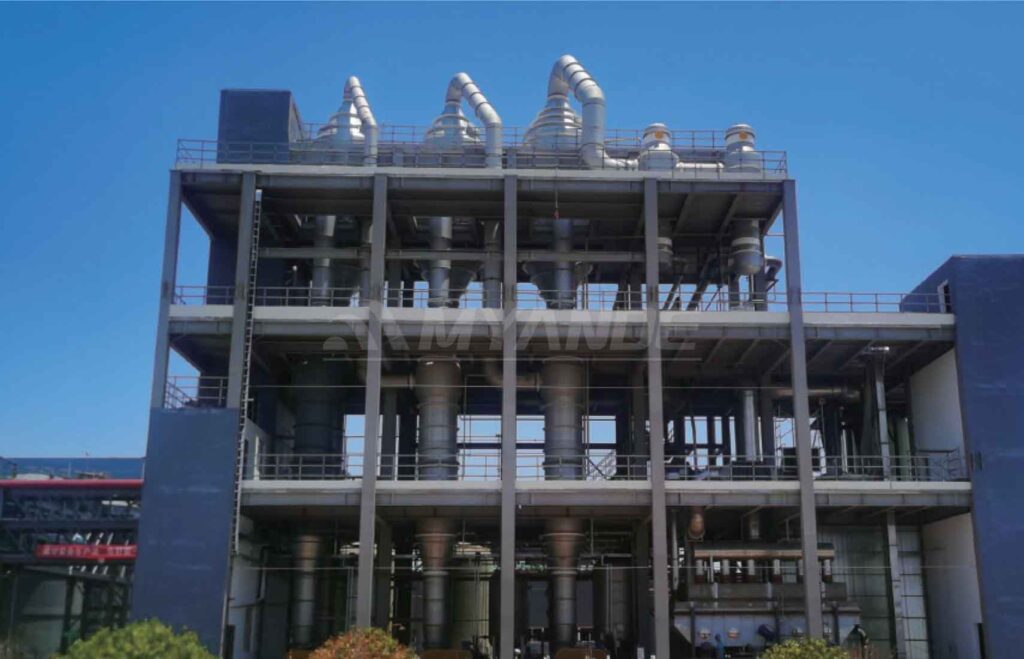
A multi-effect evaporator may be the better choice when the plant has economical steam, limited electrical capacity, moderate operating hours, or a material that requires a more conservative thermal arrangement. It can also be attractive when the project team already has steam infrastructure and maintenance experience.
Multi-effect evaporation does not mean low technology or poor efficiency. It uses staged vapor reuse and can be integrated with TVR, waste heat, or other heat sources. Its suitability depends on the number of effects, temperature levels, steam conditions, heat-transfer area, and real site economics.
Available Steam Can Change the Selection
I have seen project discussions change direction once the team clarified the actual steam source. A site may describe steam as “available,” but the engineering review still needs to confirm pressure, seasonal availability, condensate return, quality, and marginal cost.
The buyer should distinguish between:
– Existing steam with unused capacity
– Steam that requires a new boiler
– Waste heat with variable temperature
– Steam purchased from another production unit
– Steam that competes with a higher-value process
If steam is genuinely low cost and dependable, multi-effect evaporation may reduce the need for a large compressor and associated electrical infrastructure. If steam must be generated by burning fuel, the apparent simplicity may not produce the lowest total cost.
Multi-Effect Systems Also Have Technical Trade-Offs
A multi-effect system requires careful temperature and pressure allocation. The first effect operates at a higher temperature, while later effects operate at lower temperatures. The available temperature difference affects heat-transfer area and evaporation capacity.
I would ask the supplier to show:
– The design pressure and temperature of each effect
– Heat-transfer area and fouling allowance
– Expected condensate quality
– Steam consumption under normal and turndown conditions
– Cleaning method and estimated cleaning interval
– Control response during feed fluctuations
– Material compatibility and corrosion allowance
– Integration with crystallizers or dryers
A multi-effect system can still suffer from scaling, especially when concentration increases across the effects. The final effect may face low temperature differences and reduced heat-transfer performance. A design that looks efficient on paper can lose performance when fouling increases or when operators must reduce throughput to protect the equipment.
Compare Real Operating Cost, Not Purchase Price
The initial price is only one part of the decision. I use a lifecycle view that includes capital cost, energy, labor, maintenance, cleaning chemicals, replacement parts, downtime, and product or salt recovery.
| Cost category | Questions I ask |
| Capital | Does the quotation include compressor, controls, pumps, separation, and installation? |
| Energy | What are the electricity and steam assumptions at the buyer’s site? |
| Maintenance | What components require scheduled service? |
| Cleaning | How often must the system be cleaned, and how long does cleaning take? |
| Downtime | What production loss occurs during fouling or repairs? |
| Product recovery | Does the route achieve the required concentration, purity, or salt separation? |
| Expansion | Can the system handle future capacity or feed changes? |
I prefer suppliers that provide a transparent mass balance, energy balance, equipment list, and operating-cost model. I also ask them to identify assumptions that require confirmation through testing or professional engineering review.
How Should Buyers Select Between MVR and Multi-Effect Evaporation?
Buyers should select between MVR and multi-effect evaporation through a structured technical and economic evaluation. I start with the process objective, then assess the material, energy conditions, reliability risks, and downstream requirements. I do not start with a preferred equipment name.
The most reliable selection normally includes material analysis, a process concept, mass and energy balances, a utility comparison, fouling assessment, and a supplier review. Qualified engineers should confirm application-specific decisions before procurement.
Step 1: Define the Required Process Result
The buyer should state whether the system must:
– Concentrate a product for the next process
– Recover water or solvent
– Produce a saleable crystal
– Separate sodium chloride and sodium sulfate
– Reduce liquid discharge to zero
– Protect a heat-sensitive product
– Reduce boiler load
– Stabilize an upstream production process
The required result changes the equipment route. A concentration system for glucose may require different priorities from a ZLD system for chemical wastewater. A lithium salt project may need evaporation, flash concentration, cooling crystallization, solid-liquid separation, and product washing. The evaporator cannot be selected independently from that complete process.
Step 2: Build a Material and Operating Data Sheet
I recommend that buyers prepare a data sheet containing:
– Feed flow range, not only nominal flow
– Feed and target concentration
– Temperature and pressure
– Density and viscosity
– Salt composition and impurities
– Suspended solids
– Solubility data
– Scaling and fouling observations
– Corrosion requirements
– Product or crystal specifications
– Available steam and electricity
– Expected annual operating hours
When information is incomplete, I ask the supplier to state the design basis clearly. I do not treat an unverified assumption as a guaranteed performance figure.
Step 3: Request Comparable Supplier Deliverables
A fair comparison requires suppliers to use the same basis. I request the following documents:
1. Process flow diagram
2. Mass and energy balance
3. Utility consumption at normal and turndown capacity
4. Equipment and instrument list
5. Material-of-construction schedule
6. Cleaning and maintenance plan
7. Operating-cost calculation
8. Performance guarantees and exclusions
9. Pilot or test requirements
10. Installation, commissioning, and training scope
I also verify certifications, references, and quality documents rather than assuming that a certificate alone proves suitability. The buyer should confirm whether the quoted system has relevant experience with similar materials, concentrations, and process objectives.
Step 4: Consider Hybrid Routes
The best answer may combine technologies. An MVR falling-film evaporator may handle the initial concentration stage, while a forced-circulation evaporator or crystallizer handles a high-solids stream. A multi-effect system may use waste heat in one section and MVR in another. A cooling or freezing crystallization step may reduce the load on thermal equipment for selected salt systems.
I have found that this process-level thinking is especially important for high-salt wastewater, lithium materials, fermentation liquors, and chemical streams with changing viscosity. The right route is often a system architecture rather than a single evaporator type.
Frequently Asked Questions
1. Is an MVR falling-film evaporator always more energy efficient?
No. An MVR falling-film evaporator can reduce fresh-steam consumption, but it uses electricity for vapor compression. Its total energy and operating cost depend on electricity price, steam price, compressor performance, operating hours, and process conditions. I recommend comparing both utilities on the same annual production basis.
2. Can a falling-film evaporator be used in a multi-effect system?
Yes. Falling-film describes the liquid flow and heat-transfer arrangement, while multi-effect describes staged heat reuse. A falling-film evaporator can be designed as part of a multi-effect system. Buyers should ask suppliers to explain the complete thermal and material-flow arrangement.
3. Which system is better for high-salt wastewater?
Neither system is automatically better for every high-salt wastewater stream. I evaluate scaling, viscosity, suspended solids, corrosion, salt solubility, cleaning access, and the required ZLD or salt-separation result. The final system may combine falling-film, forced-circulation, crystallization, and solid-liquid separation technologies.
4. Does MVR always have a shorter payback period?
No. Payback depends on site-specific capital cost, electricity and steam prices, operating hours, capacity, maintenance, and downtime. I avoid using a universal payback period because a calculation based on unverified utility prices can mislead the buyer.
5. What should I request before comparing supplier quotations?
I recommend requesting a process description, mass and energy balance, utility assumptions, equipment scope, material-of-construction details, cleaning plan, performance guarantees, and lifecycle operating-cost model. A material assessment or pilot test may also be necessary for difficult or variable feeds.
Conclusion
An MVR falling-film evaporator can be an effective choice for high-utilization projects that value reduced fresh-steam demand, but it is not universally better than multi-effect evaporation. I compare electricity, steam, capital cost, maintenance, cleaning, downtime, material behavior, and downstream process requirements together. I also distinguish falling-film construction from the MVR-versus-multi-effect energy strategy. For a reliable decision, I recommend submitting representative material data to Myande for a project-specific process assessment, mass and energy balance, and complete technical-economic comparison.